
Budapest is one of the easiest capital cities to enjoy on a first visit if the route is planned with logic. The city is not difficult because its main value lies in a clear structure: the Danube divides two historically different urban zones, the hills shape the western side, and the flat eastern side supports long avenues, squares, and civic buildings. A first trip works best when it is built not around random landmarks, but around this contrast between Buda and Pest.
That is why a visitor should begin with a route that explains the city rather than merely filling the day, and even when people make pauses to check maps, tickets, or pages such as the chicken road casino game, the real success of Budapest comes from seeing how its geography, architecture, and public spaces connect. The city rewards sequence. One viewpoint helps decode the next district, and one district often explains why the next one developed as it did.
Understand the City Before Choosing the Stops
The first mistake in Budapest is trying to treat all major places as equal. They are not. Some locations matter because they are visually impressive, while others matter because they explain the city’s structure. Budapest becomes much more readable when you recognize that Buda offers elevation, fortification, and strategic views, while Pest offers scale, urban movement, and the civic face of the capital.
For that reason, a first-time visitor should aim for balance. It is not enough to see only the castle side and river panoramas, and it is also not enough to spend all the time on the grand boulevards and central streets of Pest. The strongest first itinerary combines river views, one hill district, one monumental civic zone, one market or bath experience, and time for walking between them. Budapest is a city that becomes convincing through transitions.
Start with the Danube and the Central Bridges
The Danube is not simply a scenic element. It is the main organizing line of Budapest. A first trip should include time on the riverbanks and at least one crossing on foot. This immediately clarifies how Buda and Pest relate to each other and why the city feels larger than many historic capitals.
The Chain Bridge is often the most useful bridge for a first visit because it connects two essential introductory areas: the central part of Pest and the lower section of Castle Hill. Crossing here helps a visitor understand the difference in terrain and urban rhythm. Pest feels wider, more administrative, and more commercial. Buda feels more defensive, elevated, and selective in its access.
The river promenade on the Pest side is also important. From there, many of Budapest’s best-known silhouettes become legible at once. Parliament, the bridges, the hilltop structures, and the curves of the Danube form one of the clearest city panoramas in Europe. This is not just a photo stop. It is the point where the whole city begins to make sense.
Include Castle Hill, but Do Not Rush It
Castle Hill should be on every first-time itinerary, but it should not be reduced to a quick checklist. This area works best when explored as a layered district rather than as a single attraction. The streets, courtyards, terraces, and viewpoints reveal how political power and topography worked together over centuries.
The main value of the hill is interpretive. From above, Budapest is easier to read. You can see the wide Pest plain, the placement of the bridges, and the way the Danube acts as a spine through the capital. The hill also introduces a different urban tempo. After the busier Pest streets, the quieter spatial rhythm here creates a contrast that strengthens the overall experience of the trip.
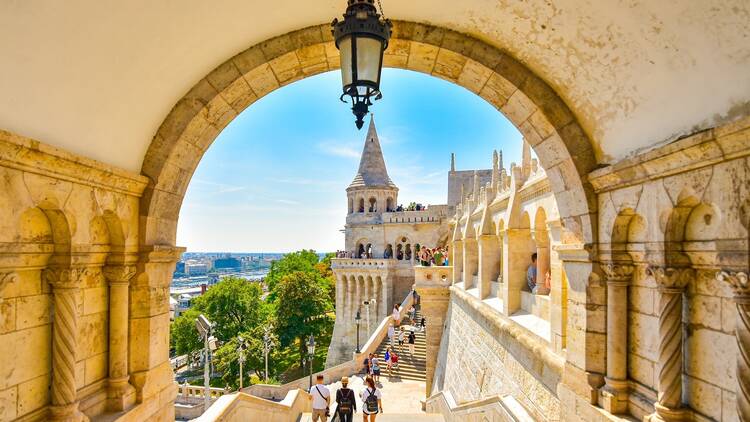
The Fisherman’s Bastion and the surrounding terraces are especially useful for first-time visitors because they combine open views with direct access to the historic core of Buda. The point is not only to stand there, but to use the viewpoint as a tool for orientation.
On the Pest Side, Prioritize Parliament, the Avenue Axis, and Central Squares
If Buda explains the city’s topography, Pest explains its ambition. The Parliament area is central to this. Even from the outside, the building communicates scale, statehood, and the period when Budapest was asserting itself as a major European capital. The square around it gives enough open space to appreciate the building properly, which matters in a city where many streets are visually dense.
From there, it makes sense to move toward the major avenue axis that structures central Pest. This part of the city shows planned growth in a more modern form than the hill district. Long, straight routes, formal facades, and major intersections reveal a different urban logic from the narrower and more organic sections closer to the river.
Large squares and public buildings on the Pest side should be included not because they are all individually unique, but because together they show how Budapest presents itself as a capital. These spaces are about civic scale, not intimacy. For a first trip, that distinction matters.
Add One Market, One Bath, and One Hill View
A city cannot be understood only through formal landmarks. Budapest becomes more complete when daily and social life are added to the itinerary. One market hall is worth including because it shows how the city functions beyond monumental architecture. Markets reveal local food habits, movement patterns, and the interaction between residents and visitors.
A thermal bath is also important on a first visit, not as a luxury extra but as part of Budapest’s identity. The city’s bath culture is tied to geology, urban life, and long historical continuity. Choosing one bath experience helps make the trip more specific and less generic.
For a second major viewpoint beyond Castle Hill, Gellért Hill is one of the best choices. It offers another reading of the city, this time with a stronger sense of the river’s curve and the wider urban spread. A first trip benefits from seeing Budapest from more than one height, because each elevation changes the interpretation.
What to Include to Avoid a Weak First Itinerary
A strong first Budapest trip should include the Danube embankment, one central bridge crossing, Castle Hill, the Parliament area, a structured walk through Pest, one market, one bath, and one high panoramic point such as Gellért Hill. This combination avoids the common mistake of seeing only isolated attractions without understanding their relationship.
Budapest is best appreciated when treated as a city of contrasts that work together: hill and plain, court and parliament, defense and display, daily life and monumental planning. On a first journey, these contrasts should shape the route. That is how Budapest stops being a list of famous places and becomes a city you actually understand.