
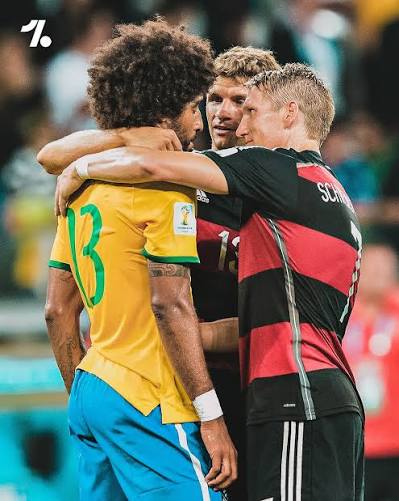
Rewatching Germany’s 7–1 demolition of Brazil at the 2014 World Cup reveals far more than a shocking score; it shows how structure, pressing, and emotional collapse can combine to turn a high‑level semi-final into a tactical avalanche. For viewers following full matches, that night in Belo Horizonte is a reference point for recognising early warning signs in big games, from midfield imbalance to uncontrolled pressing and gaps between lines that top opponents can punish relentlessly.
Why the 7–1 Matters for Live Match Understanding
The Mineirão semi-final is often treated as a one-off anomaly, but the patterns behind it—Brazil’s structural risks without key players and Germany’s ruthless exploitation of space—recur in less extreme forms in many elite matches. Watching the entire game rather than only the goals helps you learn how quickly a slightly unstable game plan can unravel when facing a well-prepared side with clear automatisms in possession and a strong out-of-possession press.
Pre-Match Context and Brazil’s Structural Risks
Brazil entered the match without Neymar and Thiago Silva, forcing changes in both their attacking focal point and defensive leadership. Scolari’s decision to maintain an aggressive, front-foot approach, with full-backs pushing high and midfielders leaving large gaps when pressing, meant that the team lacked both a reliable outlet in attack and a stable cover structure when possession was lost.
Germany’s Compact 4-2-3-1 and Flexible Occupation of Space
Germany lined up in a compact 4-2-3-1 that shifted into a 4-3-3 or 4-4-2 shape without the ดูบอลวันนี้ goaldaddy, with Kroos and Khedira controlling central zones and Özil, Müller, and Klose rotating intelligently in the final third. When you watch the match live, look at how narrow and connected Germany’s lines remain: distances between midfield and defence stay small, allowing them to collapse around the ball when Brazil try to combine centrally, then break into the open spaces behind Brazil’s advanced full-backs.
How Germany’s Early Goals Came from Repeated Patterns
The avalanche of goals between the 11th and 29th minute did not come from random chaos; it emerged from repeatable patterns in Germany’s corner routines, cutbacks, and third-man runs. Several goals feature a similar sequence: a short or quickly taken set-piece, a pass to a free player at the edge of the box, and a cutback or first-time finish, exploiting Brazil’s poor marking and lack of coordination when defending crosses and second balls.
What to Watch in Brazil’s Defensive Collapse
Brazil’s defending in this match is a live case study in how emotional urgency can destroy positional discipline. As the goals stack up, you see centre-backs stepping out without cover, midfielders chasing the ball rather than protecting passing lanes, and full-backs caught high with no staggered line behind them, leaving enormous channels for Germany to attack.
To follow this in real time, you can use a simple sequence during any rewatch:
- On each German attack, check the height and spacing of Brazil’s back line and note whether full-backs are level with centre-backs or significantly ahead.
- Watch how Brazilian midfielders position themselves when the ball is in front of them—do they hold central lanes or rush toward the ball carrier, leaving passing options behind.
- Track Germany’s first forward pass after regaining possession: is it into a huge central pocket, into the channel behind a full-back, or wide to isolate a defender.
- Before each German shot, count how many yellow shirts are actually between ball and goal versus how many are recovering from advanced positions.
- After each goal, observe whether Brazil’s shape becomes more or less compact; note how emotional reactions translate into further structural loosening.
Following this routine reveals that the 7–1 was not simply Germany taking every half-chance; it was Brazil repeatedly failing to restore any compactness or control after the first setbacks. You see defenders and midfielders acting individually rather than as a unit, which turns each German transition into a high-value opportunity instead of an isolated break.
Chance Quality, xG, and Why 7–1 Still Exceeds the Numbers
From an expected goals perspective, the match was heavily in Germany’s favour but still not “supposed” to finish 7–1: one well-known xG estimate puts Brazil at roughly 1.6 and Germany at around 3.1, a dominant edge but not a six-goal gap. That contrast shows why live viewers should treat extreme scorelines with care: Germany combined a high volume of good chances with unusually clinical finishing, while Brazil’s few decent openings either fell at poor moments or were met by solid goalkeeping.
Thinking in xG terms while watching means focusing on where Germany’s shots came from—many from central, close-range positions after cutbacks or simple through balls—compared with Brazil’s mix of crowded-box efforts and longer-range attempts once the match was effectively lost. The lesson is that dominance in chance quality can justify a clear victory even when the exact scoreline remains an outlier, so your analysis should emphasise repeatable patterns rather than the exact number of goals.
Here is an illustrative breakdown of how performance and outcome diverged:
| Metric / aspect | Brazil | Germany | Viewing takeaway |
| Goals | 1 | 7 | Scoreline reflects extreme finishing variance on top of structural superiority. |
| Shots | 18 | 14 | Brazil take more attempts, but many are low-quality, reactive efforts once game state is gone. |
| Approximate xG (public estimates) | ~1.6 | ~3.1 | Germany’s chances are consistently better; the extra goals come from exceptional conversion. |
| Defensive organisation | Highly stretched, poor tracking of runners and set-piece assignments | Compact, coordinated, strong control of central areas | Structural differences explain why similar shot numbers produce wildly different outcomes. |
By viewing the match through these lenses, you recognise that while 7–1 is historically huge, the underlying story is about Germany’s repeated access to high-probability positions and Brazil’s inability to protect those zones once their plan began to fail. That perspective makes it easier to apply lessons from this game to future semi-finals where scorelines might be tighter but the same patterns of control and collapse appear.
How Live Viewing Changes the Emotional Narrative
When you ดูบอลสด a full replay instead of just the goal clip montage, you experience the gradual unraveling: the crowd’s shift from anticipation to disbelief, Brazil’s body language changing with each concession, and Germany’s calm insistence on their structure. Watching the non-scoring phases—Germany’s simple passing triangles, the way they slow the tempo after gaining a big lead, and Brazil’s increasingly desperate long balls—shows how emotion and game state shape decisions on the pitch more than any pre-match plan.
What Strengthened Germany and Weakened Brazil on the Night
Germany’s key strength was their balance: a midfield that could both press and circulate, defenders comfortable stepping into midfield, and attackers willing to rotate positions without losing spacing. Brazil’s weaknesses were the mirror image—overreliance on direct running, gaps between their lines, and a lack of alternative structures once their initial high-energy approach stopped working—making them unusually vulnerable to a side that attacked space intelligently.
Summary
Germany’s 7–1 win over Brazil in 2014 stands as a dramatic reminder that extreme scorelines can emerge when sound structure, clinical finishing, and an opponent’s emotional collapse intersect. For live viewers, focusing on line spacing, pressing triggers, and chance locations rather than just the number of goals turns this famous semi-final into a lasting guide for reading big matches, helping you spot early signs of control or unraveling whenever you watch future tournament knockouts.