
Introduction
Open-plan offices are designed to make workplaces feel connected, flexible and collaborative. Employees can communicate easily, teams can share resources and businesses can adapt workstations as their needs change. Yet there is one challenge that can undermine all of these advantages: uncontrolled sound.
When conversations, telephone calls, meetings, movement and equipment noise all occupy the same space, the office can quickly become difficult to work in. Employees may find it harder to concentrate, while private discussions can become audible across the room.
Improving open plan office acoustics does not necessarily mean adding permanent walls or turning an open workplace into a collection of individual rooms. With the right combination of acoustic treatments, furniture planning and zoning, businesses can create a quieter and more comfortable environment while retaining the flexibility that made the open layout attractive in the first place.
1. Identify Where the Noise Problem Starts
Before choosing acoustic products, it is worth understanding how sound behaves throughout the workplace.
Noise rarely affects every part of an office equally. A collaboration zone may naturally be louder because employees gather there to discuss projects. A bank of desks positioned beside a meeting area may experience more disruption than workstations located elsewhere.
Large rooms with hard surfaces can make the problem more noticeable because sound can reflect from ceilings, walls and other surfaces. High ceilings can also increase the distance sound travels before it loses energy.
Start by observing the workplace during normal working hours.
Look for areas where:
- Several conversations happen simultaneously
- Employees frequently complain about distractions
- Meeting spaces are close to individual workstations
- Sound appears to bounce around the room
- Telephone and video calls create competing noise
- Employees struggle to find quiet areas
- Large reflective surfaces dominate the interior
Understanding these patterns makes it easier to decide where acoustic treatment will have the greatest impact.
2. Use the Ceiling to Control Sound From Above
The ceiling is one of the most useful areas for improving the acoustic performance of a large office.
This is especially true in workplaces with open or high ceilings, where sound can travel freely through the room. Suspended acoustic products can introduce additional sound absorption without using valuable floor space.
Acoustic Baffles
Vertically suspended baffles can be positioned throughout an open office to help absorb reflected sound. Because they hang from the ceiling, they can be used without taking up desk or circulation space.
Their shape, colour and arrangement can also be customised, allowing them to become part of the interior design rather than looking like an added technical feature.
Acoustic Rafts
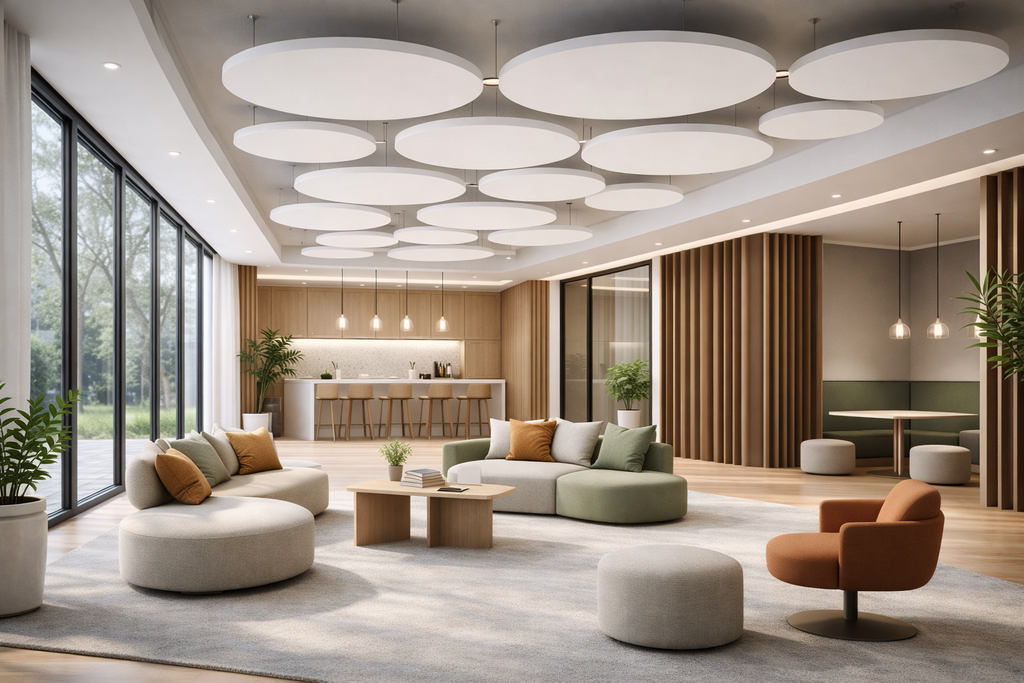
Horizontally suspended rafts provide another option. They can be particularly useful above meeting areas, collaborative zones and other spaces where controlling reflected sound is important.
A well-planned ceiling treatment can therefore contribute to both the acoustic and visual character of an office.
3. Treat Reflective Walls
Ceiling treatment alone may not be enough if an office contains extensive hard wall surfaces.
Sound can bounce between opposing walls, creating reverberation and making speech less distinct. Acoustic wall panels can introduce absorptive surfaces into these areas.
Wall treatments can also provide an opportunity to introduce colour, texture, graphics or patterns into the workplace.
This means acoustic treatment does not have to compromise the appearance of an office. In fact, a carefully designed wall installation can become one of the room’s main decorative features.
For businesses refreshing an existing interior, wall panels can be particularly useful because they can often be introduced without making major structural changes.
4. Create Smaller Acoustic Zones
One of the biggest challenges with open-plan offices is that the entire floor can effectively behave like one large sound environment.
The answer is not always to close everything off.
Instead, businesses can create smaller acoustic zones within the larger space. Screens, partitions and desk dividers can help establish boundaries between different activities.
For example, a workplace could include:
Focus areas:
Designed for employees carrying out tasks that require concentration.
Collaboration areas:
Spaces where conversations and group discussions are expected.
Meeting areas:
Dedicated locations for presentations, calls and team meetings.
Breakout areas:
More informal spaces where employees can communicate without disturbing people working nearby.
This zoning approach is one of the most practical ways to improve open plan office acoustics while maintaining an adaptable floor plan.
5. Add Acoustic Screens Where They Are Most Useful
Acoustic screens can provide both sound and visual separation.
Unlike permanent walls, many screen systems can be moved or repositioned as the workplace changes. This makes them particularly suitable for businesses that regularly reorganise desks or introduce new teams.
A screen positioned between workstations can create a stronger sense of personal space. Screens can also be used around collaboration areas to reduce the direct spread of sound into nearby working zones.
Their flexibility is particularly valuable in coworking environments and offices where different groups use the same space throughout the day.
6. Improve Individual Workstations
Not every acoustic problem requires a room-scale solution.
Sometimes the most effective improvement can happen directly around the workstation.
Desk dividers can create a degree of sound and visual separation between employees sitting close together. They can help reduce the sense of exposure that often comes with completely open desks.
Acoustic desk products can be particularly useful where the office needs to remain open but employees still require some protection from surrounding activity.
For people carrying out concentrated computer work, even a modest increase in separation can make the workstation feel more comfortable.
7. Use Acoustic Pods for Tasks That Need More Privacy
Some activities simply require greater acoustic separation than a desk divider can provide.
Video conferences, private conversations, interviews and concentrated individual work may benefit from an enclosed or semi-enclosed space.
Acoustic pods can provide these areas without requiring the business to construct additional permanent rooms.
They can be introduced into larger office layouts as dedicated spaces for focused tasks. This creates a useful middle ground between an entirely open desk environment and traditional enclosed offices.
For growing businesses, pods can also offer flexibility because they can become part of a changing workplace layout.
8. Consider Acoustic Lighting
Lighting is already an essential part of workplace design, so combining it with acoustic performance can make efficient use of the available space.
Acoustic lighting systems integrate sound absorption with illumination, allowing a single feature to perform two functions.
These solutions can be useful where ceiling space is limited or where designers want to reduce the number of separate elements hanging above the workplace.
Instead of treating lighting and acoustics as completely separate design decisions, integrated products can help create a more coordinated ceiling.
9. Use Partitions Without Making the Office Feel Closed
Permanent walls can reduce flexibility, but completely open spaces are not always appropriate for every task.
Movable acoustic partitions offer another option.
They can be used to divide larger spaces temporarily, create meeting areas or establish quieter sections within an open floor. When the business changes its layout, the partitions can potentially be repositioned to suit the new arrangement.
This adaptability makes acoustic partitions useful for modern offices where space requirements can change quickly.
They also allow businesses to introduce separation without losing the visual openness associated with contemporary workplace design.
10. Choose Sustainable Acoustic Materials
Acoustic performance is not the only consideration when selecting workplace products.
Many businesses are also paying greater attention to the environmental impact of the materials used in their interiors.
Acoustic products can be manufactured using materials such as recycled PET and glass wool, while responsible manufacturing practices can help reduce environmental impact.
For businesses working toward broader sustainability objectives, selecting acoustic products with appropriate material credentials can make the workplace improvement part of a wider environmental strategy.
11. Think About Appearance as Well as Performance
An acoustic product can perform extremely well but still feel out of place if it does not complement the interior.
Modern acoustic systems offer opportunities to customise colours, fabrics, felt finishes, shapes and patterns. This allows designers to coordinate sound treatment with the rest of the workplace.
For example, a company could use subtle tones in a professional office, brighter colours in a creative environment or distinctive shapes to reinforce a particular interior concept.
The best acoustic installations often become almost invisible as technical solutions because they have been integrated so naturally into the design.
12. Build an Acoustic Strategy Instead of Buying Random Products
A common mistake is to purchase acoustic panels simply because an office is noisy.
Products are more effective when they form part of a wider strategy.
Consider the entire workplace and ask:
- Where is sound being generated?
- Where does it travel?
- Which areas need concentration?
- Which spaces are intended for collaboration?
- Where is privacy important?
- Which surfaces reflect the most sound?
- Can furniture or zoning reduce unnecessary sound movement?
- Which acoustic products fit the existing interior?
The answers can help determine whether the workplace needs ceiling treatments, wall panels, desk dividers, screens, partitions, pods or a combination of several approaches.
Benefits of Improving Open Plan Office Acoustics
A carefully planned acoustic environment can offer practical benefits throughout the working day.
Better Concentration
Reducing unwanted background sound can make focused tasks more comfortable.
Improved Speech Clarity
Controlling reverberation can help conversations and meetings become easier to follow.
Greater Privacy
Screens, desk dividers, pods and partitions can provide additional separation for sensitive or focused activities.
More Flexible Space
Movable acoustic products can allow businesses to adapt their workplace without undertaking major construction.
Improved Employee Comfort
A workplace with better sound control can feel less overwhelming, particularly during busy periods.
Stronger Interior Design
Modern acoustic products can contribute colour, texture, shape and visual interest while serving a practical purpose.
Conclusion
Improving an open office is not simply a matter of making it quieter. The real objective is to create a workplace where different activities can coexist without constantly interfering with one another.
Effective open plan office acoustics begins with understanding how sound moves through the space. From there, businesses can combine ceiling baffles, acoustic rafts, wall panels, screens, desk dividers, pods, lighting and movable partitions according to the specific requirements of each area.
For anyone wondering how to improve open plan office acoustics, the strongest approach is usually a combination of targeted treatments rather than relying on one product. By considering sound alongside workplace behaviour, interior design, flexibility and sustainability, businesses can create open offices that remain collaborative while becoming considerably more comfortable and productive places to work.